
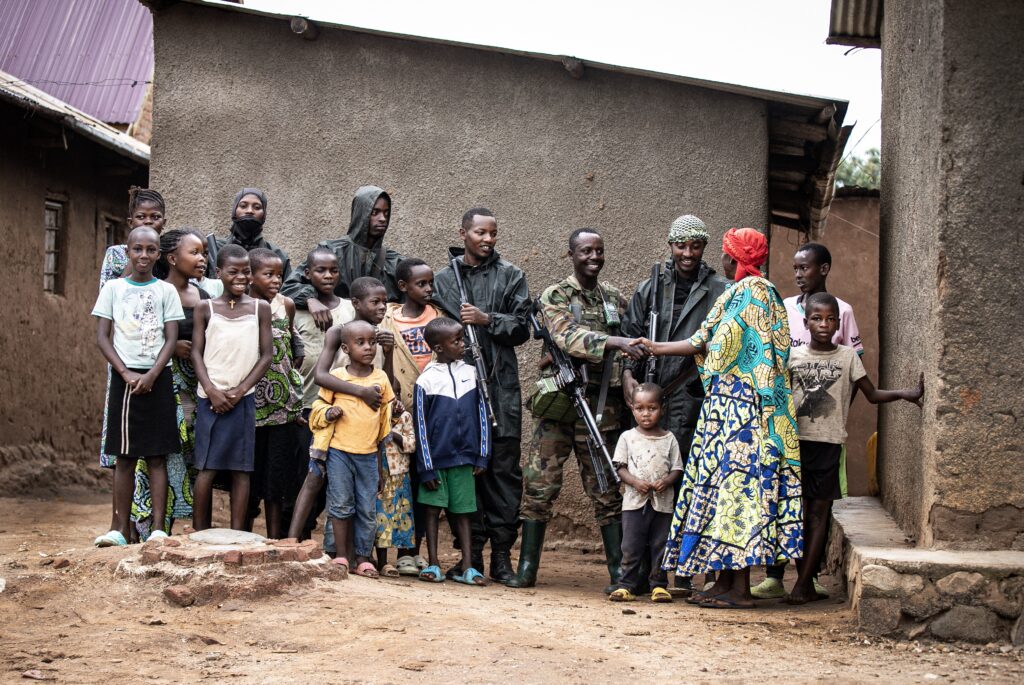
Banyamulenge women and children displaced from Minembwe and Uvira greeting AFC/M23 soldiers in Kamanyola, South Kivu, January 2026 (Photo by Teddy Mazina)
By Bojana Coulibaly
The 2026 final report of the UN Group of Experts on the Democratic Republic of Congo (DRC), released this month, is already being treated by the media and some international experts as an authoritative account of who is responsible for violence, and who is most at risk.
Yet behind the technical language and dense footnotes lies a deeply unbalanced narrative that distorts the hierarchy of perpetrators, normalizes state collusion with genocidal actors, and downplays the existential threat facing Tutsi/Banyamulenge communities. This is not just an academic concern. In eastern Congo today, the way the international community assigns blame and responsibility can mean the difference between protection and annihilation for entire communities.
Inflating AFC/M23 While Downplaying Major Atrocity Perpetrators
The report claims that multiple parties commit serious violations of international humanitarian and human rights law. Yet it elevates the AFC/M23 movement and the Rwandan Defence Force (RDF) as the principal culprits among both non‑state and state actors, especially on conflict‑related sexual violence. This is done without a credible factual basis and rests heavily on reporting and information flows that are shaped and manipulated by Kinshasa.
By contrast, the Allied Democratic Forces (ADF), the single largest perpetrator of mass atrocities in eastern DRC, is relegated to the background. The ADF is responsible for extremely high civilian casualties, massacres, abductions, and sexual violence. Still, its central role is comparatively downplayed, leaving readers with a distorted image in which AFC/M23 appears as the primary threat to civilians.
The same pattern emerges with other armed actors. Serious abuses by CODECO and the many militias aligned with the Congolese army (FARDC) are underweighted, despite the sheer scale of the violence they inflict. The result is a misrepresentation of the hierarchy of perpetrators: ADF and CODECO violence is minimized, while allegations against AFC/M23 are amplified.
Drone Warfare: False Equivalence in the Skies
This asymmetry runs through the report’s treatment of new military technologies, particularly drone warfare. The Group tries to “balance” responsibility by placing FARDC and AFC/M23 on the same footing. Yet existing data, including from independent monitoring organizations, show that the Congolese government is responsible for the largest proportion of drone strikes in eastern DRC, with repeated attacks on densely populated civilian areas.
While AFC/M23 drone use has primarily focused on military targets and infrastructure, FARDC and its foreign “contractors” – in practice mercenaries – have conducted strikes that have killed and maimed civilians and hit humanitarian facilities, including incidents in Masisi (2 January 2026) and Goma (11 March 2026). A balanced assessment of drone warfare would distinguish clearly between targeted military operations and indiscriminate or reckless strikes on civilians. Instead, the report fails to unequivocally condemn FARDC‑linked attacks or assign responsibility where evidence clearly points to Kinshasa.
State–FDLR–Wazalendo Alliance: The Core Structural Driver
Perhaps the most alarming omission, however, concerns the Congolese state’s partnership with the Democratic Forces for the Liberation of Rwanda (FDLR) and state‑backed militias operating under the banner of “Wazalendo.”
The Group itself documents structured, ongoing cooperation between FARDC and the FDLR, a sanctioned group rooted in the forces that carried out the 1994 genocide in Rwanda. It notes high‑level meetings to continue joint operations, the delivery of arms and ammunition by FARDC helicopters, and FDLR liaison officers traveling on FARDC aircraft while coordinating closely with Wazalendo militias.
Yet the report soft‑pedals FARDC’s responsibility. The national army is treated as a “necessary state actor” rather than as a force that has made a deliberate choice to partner with a genocidal group and to outsource violence to militias it arms, funds, trains, and pays. Wazalendo are presented as “local patriotic militias,” obscuring the reality that they effectively function as a state‑backed militia and reserve force.
This alliance is not an incidental feature of the conflict. It is the core structural driver: a Congolese state that continues to rely on FDLR and proxy militias, in direct violation of peace commitments made in Washington, Doha, and Luanda, and in direct contradiction to any claim that Kinshasa is protecting all its citizens equally. For Tutsi and Banyamulenge communities, this is not theory. It is an existential threat.
Rwanda’s Security Concerns and AFC/M23’s Stated Role
In this context, the Group’s treatment of Rwanda’s security concerns and AFC/M23’s role is especially troubling. The report effectively rejects Rwanda’s right of self-defense, ignoring documented cross‑border attacks and explicit threats by Congolese officials, including open political and military support for the FDLR with the stated aim of regime change in Kigali.
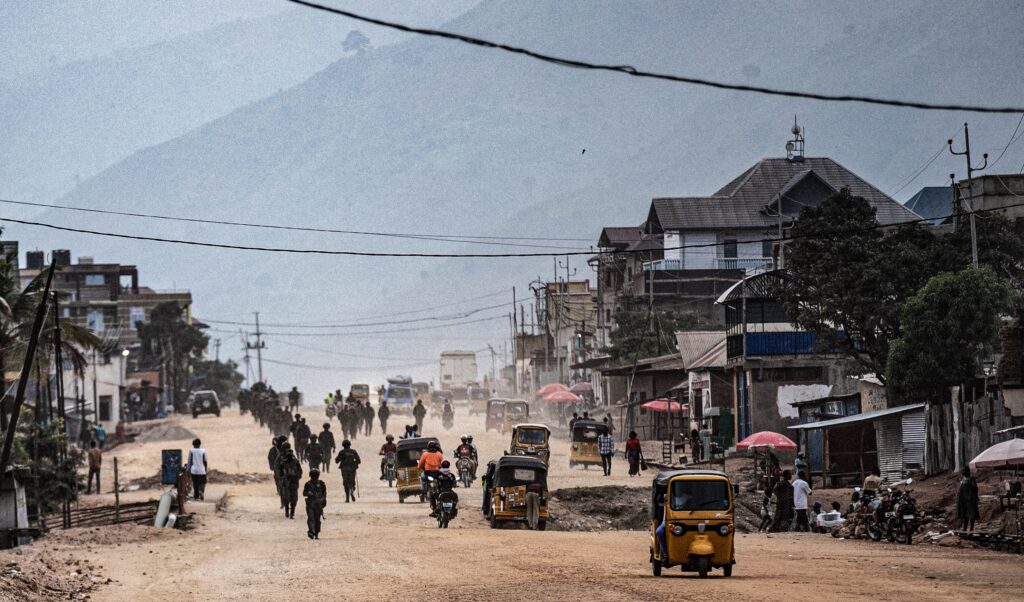
AFC/M23 soldiers withdrawing from Uvira on January 15, 2026 (Photo by Teddy Mazina)
Meanwhile, AFC/M23’s stated objective of protecting Tutsi/Banyamulenge communities from genocidal threats is casually dismissed. Kinshasa’s support to the very group that emerged from the perpetrators of the 1994 genocide is not framed as the direct genocide threat that it is.
Instead, allegations against AFC/M23, such as forced recruitment (including of minors), conflict‑related sexual violence, and obstruction of humanitarian access, are repeated on the basis of pro‑Kinshasa narratives, social‑media propaganda, and remote testimony. At the same time, the report ignores the practical reality that in many areas humanitarian agencies depend on AFC/M23‑provided security and access to reach vulnerable populations.
Where AFC/M23 and local authorities have created basic governance, security, and economic structures in long‑neglected territories, the Group labels this a “parallel state.” But these are areas abandoned for decades by Kinshasa. To residents, rudimentary administration and protection are not secessionist projects, they are the very minimum of what any state should provide.
The Banyamulenge Under Siege
Nowhere is the cost of this skewed narrative clearer than in the Banyamulenge highlands. The report describes Minembwe and surrounding Banyamulenge areas as effectively encircled by FARDC, Wazalendo, and elements of the Burundian army (FDNB), with land routes and markets cut and access reduced to limited air operations. Yet it stops short of naming this as what it is: a deliberate campaign of persecution and collective punishment against a specific ethnic community.
It also downplays or denies evidence of targeted killings of Banyamulenge civilians, including children and the elderly, while giving credence to unfounded claims that Banyamulenge self-defense groups such as Twirwaneho/MRDP are backed by Burundian rebel movements like RED‑Tabara or FNL. By reproducing Bujumbura’s narrative, the report risks justifying further operations against the very communities now under siege.
The siege and systematic isolation of Banyamulenge areas constitute a central atrocity risk in eastern DRC. To downplay this reality while questioning the legitimacy of community self-defense is not just analytically flawed, it is morally unacceptable.
Foreign Mercenaries and Escalation of Violence
The report’s handling of foreign private military companies (PMCs) is equally inadequate. The Group notes their role in planning, targeting, and operating FARDC air and drone assets, and in training Wazalendo and notorious warlords such as Yakutumba, individuals already under sanctions for egregious abuses. But it fails to draw the obvious conclusion that these activities clearly violate the UN sanctions regime and the African Union Convention on Mercenarism, and are a major trigger for Banyamulenge self-defense mobilization and AFC/M23’s engagement.
Training and enabling sanctioned warlords and abusive militias through foreign PMCs is not a side note. It is a central driver of escalation and should be treated as a primary sanctions violation.
Methodological Flaws and Access Asymmetries
Beneath these substantive problems lies a deeper methodological flaw. The Group concedes that it had no physical access to AFC/M23‑controlled areas and relied largely on remote interviews, detainee testimony, and satellite imagery. This structural “access asymmetry” means that evidence from Kinshasa‑controlled zones is privileged, while information from AFC/M23‑administered areas and from targeted communities themselves is systematically under‑represented.
Under such conditions, the report cannot reasonably be treated as a fully credible or impartial assessment, particularly where it makes strong claims about AFC/M23 and Rwanda.
What a Truly Balanced Approach Requires
None of this is to deny that all armed actors, including AFC/M23, must be held to international law. Nor is it to suggest that Rwanda or any regional actor should be immune from scrutiny. It is to insist that the international community cannot afford analysis that obscures the central role of ADF, CODECO, FARDC, FDLR, Wazalendo and foreign PMCs in driving atrocities, while disproportionately and uncritically amplifying allegations against those who are engaged in protecting besieged communities.
If the UN and its member states are serious about preventing another genocide in the Great Lakes region, they must demand better: a genuinely evidence‑based, balanced approach that confronts state–FDLR collusion head‑on, recognizes the siege conditions and atrocity risks facing Tutsi/Banyamulenge communities, and draws a sharp line between those deliberately targeting civilians and those acting in self-defense in areas long abandoned by the state.
Anything less is not neutrality. It is complicity.