
By Bojana Coulibaly and Teddy Mazina
Since 1994, Rwanda has faced not only the legacy of the genocide against the Tutsi, but a long-term political and military project aimed at reversing the outcome of that war. This project has constantly changed its language and instruments: from the seemingly benign calls for an “inter‑Rwandan dialogue” in European capitals, to legal warfare in foreign courts, and today to open calls by neighboring heads of state for regime change in Kigali, backed by armed coalitions operating from eastern Congo. Tracing this evolution shows that Rwanda’s security crisis is not an accidental by‑product of events in the Democratic Republic of Congo, but the continuation of a sustained campaign in which the same networks continually reappear through political parties in exile, religious and lay organizations in Europe, and the genocidal militia the Democratic Forces for the Liberation of Rwanda (FDLR).
In the late 1990s and early 2000s, Rwandan opposition groups in Europe promoted the notion of an “inter‑Rwandan dialogue” as the supposed key to reconciliation and democratization. Belgium became the principal hub of this agenda. Several exiled political movements, including the RDR, the FDU and other platforms, formed coalitions such as Igihango. The Igihango coalition, formally known as the Alliance for Democracy and National Reconciliation (ADRN‑Igihango), was a coalition of Rwandan opposition groups formed in exile around 2002. It brought together the FDLR, the Rwandan Alliance for the Renaissance of the Nation (ARENA), and the monarchist group Nation–Imbaga y’Inyabutatu Nyarwanda. Presented as an alliance for democracy and reconciliation, ADRN‑Igihango in fact institutionalized the political partnership between a genocidal armed movement, republican opposition currents and monarchist circles, and sought to position this constellation as a legitimate interlocutor for any future political settlement in Rwanda. These initiatives were presented as neutral forums for dialogue among Rwandans, yet they treated as legitimate actors those who were directly descended from the former army and militias responsible for the 1994 genocide. In practice, the “dialogue” formula sought to reinsert these actors into Rwanda’s political life as if the genocidal project they embodied had been merely one side among others in a conventional civil war.
Belgian political and diplomatic circles repeatedly entertained and amplified these efforts. Many of the FDLR’s top political figures settled in Belgium, where they could operate with relative ease and benefit from sympathies inside parts of the political class and civil society. Belgian diplomats in the Great Lakes region maintained close contact with Rwandan opposition figures abroad, while their informal associates acted as conduits between European networks and prominent defectors from the Rwandan Patriotic Front. In this way, personal, political and intelligence relationships helped connect ex‑RPF dissidents, FDLR structures and European interlocutors around a common objective, i.e., to reshape Rwanda’s internal political settlement without acknowledging the foundational rupture represented by the genocide.
The push for an “inter‑Rwandan dialogue” also drew support from Catholic‑linked organizations in Spain and Italy, which simultaneously defended FDLR interests, promoted political talks with Kigali, and funded legal actions targeting Rwandan officials. In Spain, the charity Fundació S’Olivar, based in the Balearic Islands, received substantial public funding from municipal solidarity funds over several years. These resources were explicitly devoted to sustaining the prosecution of RPF officials before Spanish courts under universal jurisdiction provisions. At the same time, personnel linked to this organization, and to other church-related initiatives, maintained contacts with FDLR officers and intermediaries who moved between eastern Congo and Tanzania, providing them with logistical and financial support. Political activism in favor of an “inter‑Rwandan dialogue,” humanitarian discourse and legal proceedings in European jurisdictions thus became three complementary instruments in a broader campaign to delegitimize the post‑genocide Rwandan state and to rehabilitate the actors that had been militarily defeated in 1994.
A similar dynamic was visible in the activities of the lay Catholic community of Sant’Egidio in Rome. Known internationally for its role in brokering the 1992 peace accord in Mozambique, Sant’Egidio sought on several occasions to host or facilitate talks between the Rwandan government and the FDLR. Meetings and draft declarations framed the latter as a political actor capable of transformation through dialogue. Kigali, however, consistently rejected this approach, arguing that it ignored the group’s direct lineage from the Interahamwe and former Rwandan army units that had planned and executed genocide. Tensions peaked when efforts were made to bring FDLR commanders to Rome under the auspices of peace facilitation, as it appeared to be a clear attempt to normalize and rehabilitate genocidal leadership under the moral cover of a religious community.
As the Rwandan government refused to negotiate with armed groups implicated in genocide, the “inter‑Rwandan dialogue” track failed to produce results. In this context, a part of the opposition shifted towards a more explicit regime‑change discourse. Defectors from the RPF, particularly from its security services, created the Rwanda National Congress (RNC), which coordinated closely with FDLR and other armed formations in eastern Congo. Their political documents no longer concealed the objective of overthrowing the Rwandan government, by force if necessary, and constructing a new power arrangement that would include exiled elites from both the former regime and the post‑1994 period.
The chronic instability of the Democratic Republic of Congo and the weakness of state authority in its eastern provinces created a permissive environment for this agenda. FDLR and allied militias embedded themselves in local conflicts and economies, while preserving their strategic aim of returning to Rwanda and seizing power. Over time, these forces became integrated into Congolese coalitions formed to fight the M23 rebellion and what Kinshasa termed “Rwandan aggression.” By the mid‑2020s, operations by the Congolese armed forces in North and South Kivu increasingly relied on partnerships with FDLR units and other militias, grouped into the label wazalendo, which was presented as a self-defense group, while officially integrated into the Congolese army reserve. What had originally been framed in Europe as a project of political dialogue thus reappeared in the Great Lakes as an armed front structurally connected to the Congolese state.
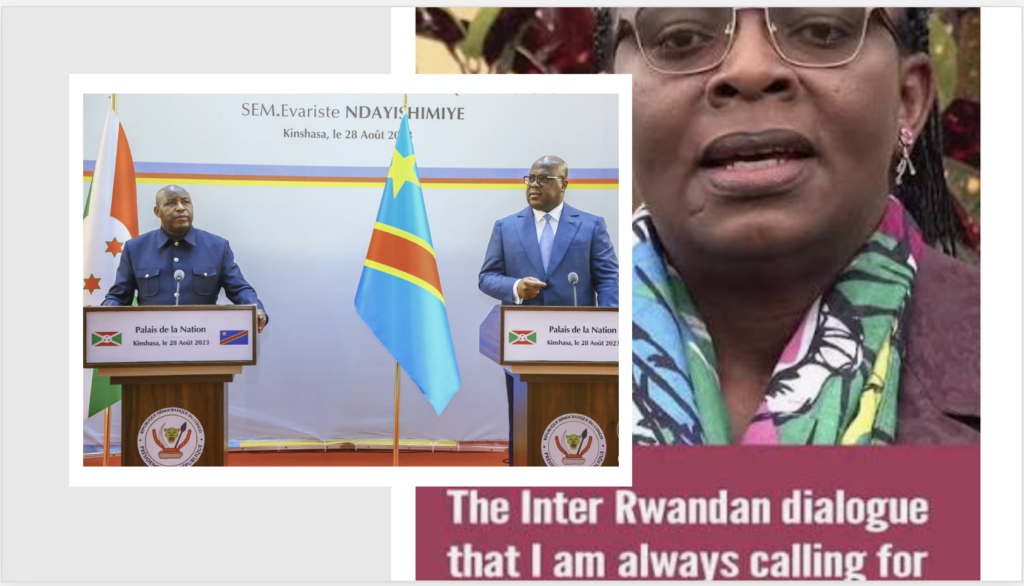
The discursive shift from dialogue to regime change is particularly visible in the public statements of the current Congolese and Burundian presidents. Since 2022, DRC’s President Félix Tshisekedi has regularly distinguished between the “Rwandan people” and the “Kigali regime,” while escalating his language against Rwanda’s leadership. In speeches to domestic audiences and in regional fora, he has suggested that peace in eastern Congo is impossible as long as the current government remains in power in Kigali, has spoken of the need for Rwandans to “free themselves” from their leaders, and has portrayed the removal of those leaders as a legitimate political horizon. Although he stops short of openly declaring a policy of regime change, the cumulative effect of these pronouncements is to encourage the idea that the Congolese state and its allies are engaged in a struggle not merely against supposed Rwandan interference in Congo, but against the very continuity of Rwanda’s post‑genocide political order.
Burundian President Évariste Ndayishimiye has gone even further in personalizing the conflict and promising support for political change in Rwanda. In several high‑profile speeches, including in Kinshasa, he has explicitly told Rwandan youth that they should rid themselves of their government and has pledged Burundian solidarity in that effort. Such language amounts to a direct call for regime change in a neighboring country. It has not remained at the level of words as Burundian troops are deployed in eastern Congo alongside the Congolese army, and various reports link elements of the Burundian security apparatus to armed coalitions that include the FDLR and that target Rwanda as well as Tutsi‑identified communities in the region.
Events on the ground since January 2025 illustrate clearly how this rhetoric has been translated into a concrete military configuration. As M23 forces advanced on Goma, Congolese troops and their allies, among them FDLR contingents, engaged in heavy fighting around the city. Rockets and shells fired from Congolese territory landed across the border in Rwanda, killing and injuring civilians in Rubavu district. This episode was a manifestation of an emerging front in which the Congolese army, genocidal remnants and Burundian troops operate together under political leadership that openly questions the legitimacy of Rwanda’s government.
Since then, joint operations by Congolese and Burundian forces in areas such as the Ruzizi plain and the high plateaus of South Kivu have intensified. Localities such as Minembwe and strategic positions like Point Zero have become focal points of a wider struggle that is simultaneously local, national and regional. For communities on the ground, these battles are framed as conflicts over land and identity. For the coalition of forces arrayed against Kigali, they serve as opportunities to consolidate rear bases, accumulate weaponry and prepare possible axes of advance towards the Rwandan border. The integration of FDLR elements and other anti‑Rwandan groups into these coalitions reinforces the perception that the region is witnessing a progressive militarization of a long‑standing regime‑change project.
Viewed over three decades, several constants emerge. The first is the continuity of actors. FDLR and its political allies have remained at the heart of anti‑Kigali networks, whether in the salons of Brussels and Madrid, in church compounds around Lake Tanganyika, or in the forests of North and South Kivu. The second is the recycling of language. Expressions such as “inter‑Rwandan dialogue,” “inclusive political settlement” and “liberating Rwanda” have appeared in different contexts, including in European non‑governmental initiatives, opposition manifestos, and today presidential speeches in Kinshasa and Bujumbura. They all point to the same underlying ambition, i.e., revisiting the political outcome of the genocide and delegitimizing the post‑1994 Rwandan state.
A third constant is the instrumentalization of law and religion. Catholic‑linked organizations and lay communities have, at various moments, offered platforms, funding and moral legitimacy to actors connected to the genocidal cause, while universal jurisdiction cases in European courts have been used to place Rwandan officials in the dock and to construct a narrative of moral equivalence between those who organized genocide and those who halted it. Finally, there has been a progressive militarization of what began as soft‑power initiatives. Lobbying, conferences and court cases have increasingly merged with armed projects in eastern Congo, until, in the current moment, there exists a convergence between neighboring state forces, genocidal remnants, local militias and an overt discourse of helping Rwandans to overthrow their leaders.
For Rwanda, this configuration represents more than a conventional border dispute. It constitutes a cumulative security threat that reaches back to 1994: a genocidal movement that never abandoned its political objectives, external networks that tried to rehabilitate that movement through the rhetoric of dialogue and human rights, and now neighboring governments that echo the old slogans of “liberating Rwanda” while integrating FDLR elements into their war coalitions. The language has shifted from conferences in European capitals to presidential podiums in the Great Lakes, but the objective has remained constant.
The current peace arrangements in the Great Lakes region are closely intertwined with the normalization of genocidal forces, the use of legal and humanitarian discourse against a state that ended genocide, and the open sponsorship of regime change by neighboring governments. These dynamics position Rwanda’s post‑genocide polity in a situation of continued vulnerability, as actors linked to past genocidal projects have adjusted their vocabulary and instruments over the past three decades while maintaining their original goals.