
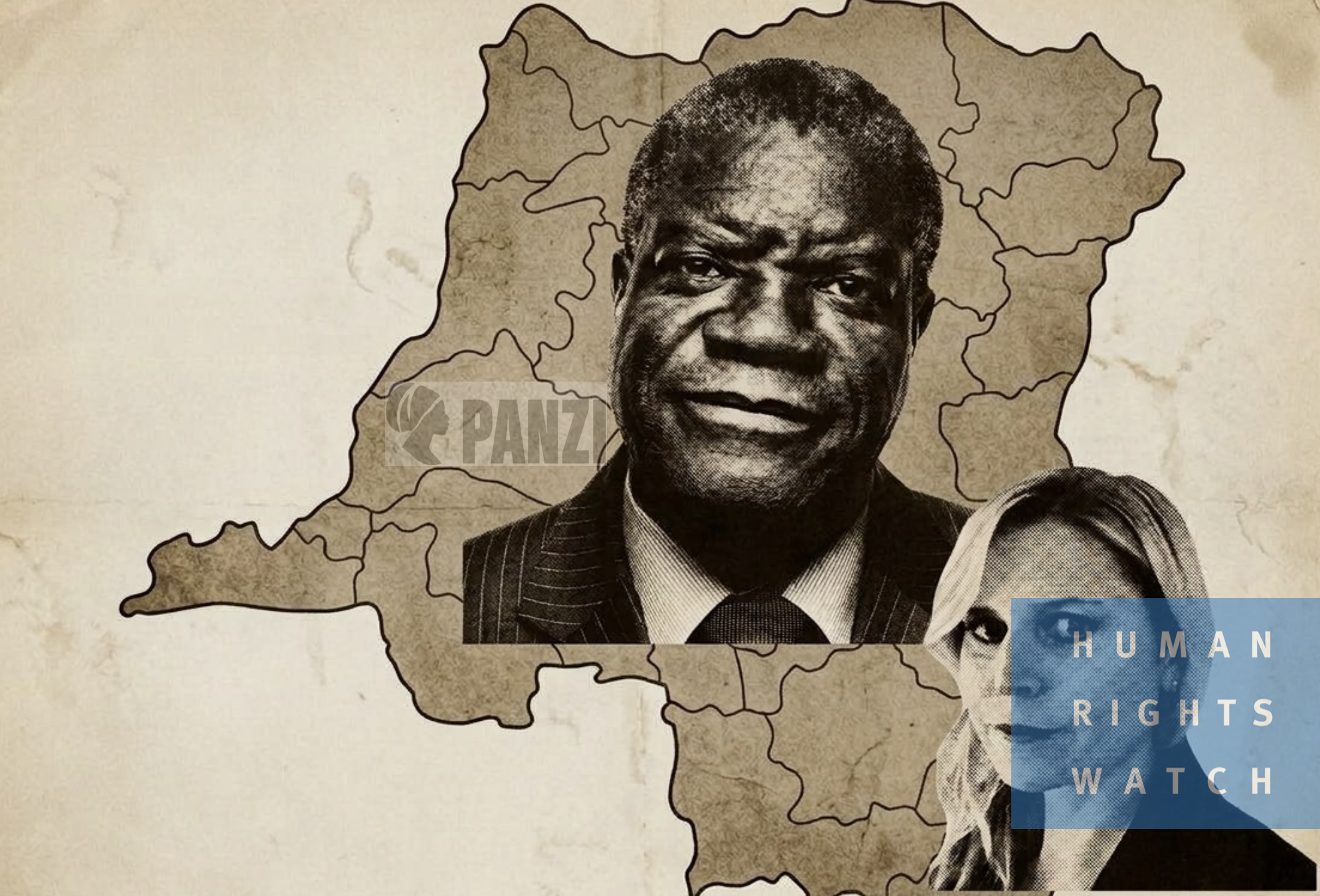
By Bojana Coulibaly and Teddy Mazina
The Anatomy of a Calculated Silence
On October 6, 2026, the René Cassin Foundation organized a high-profile panel discussion in Strasbourg (France), titled “30 Years of War, 30 Years of Impunity,” tracing the genesis of the conflict in the Democratic Republic of the Congo (DRC) back to October 6, 1996, two weeks prior to the official outbreak of the First Congo War. Moderated by French journalist Christophe Rigaud, editor-in-chief of Afrikarabia, the panel featured Nobel Peace Prize laureate Dr. Denis Mukwege and Ida Sawyer, Director of the Crisis, Conflict and Arms Division at Human Rights Watch (HRW).
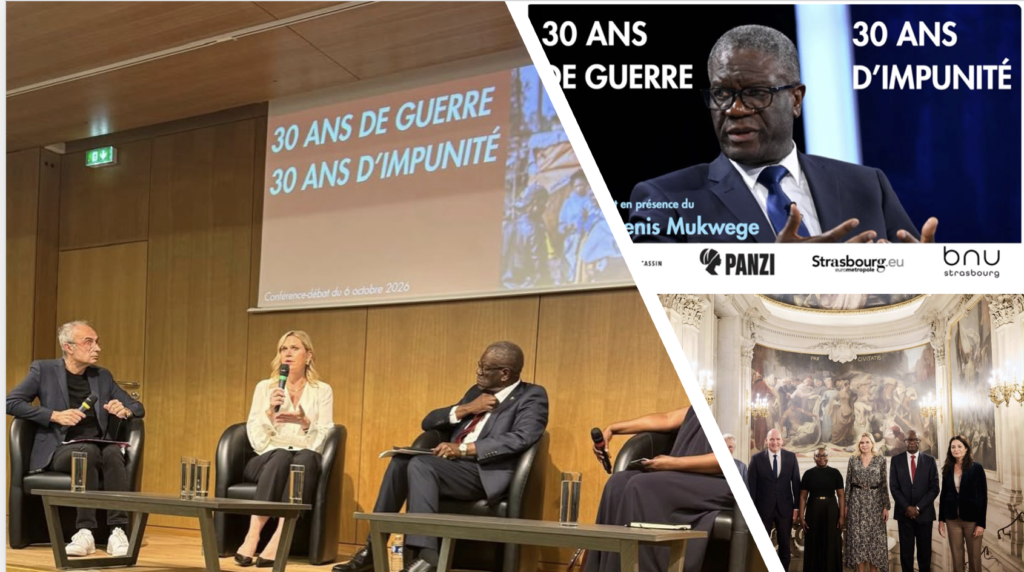
Throughout the two-hour and thirty-minute proceedings, the panelists provided an extensive narrative concerning three decades of violence, humanitarian devastation, and systemic sexual violence in eastern Congo. The blame was systematically channeled toward successive Congolese rebel movements, specifically the AFDL, RCD, CNDP, M23, and the current AFC/M23, now Front pour la Refondation de la Nation (FRN), which the panel described as regional proxy formations supported by Rwanda.
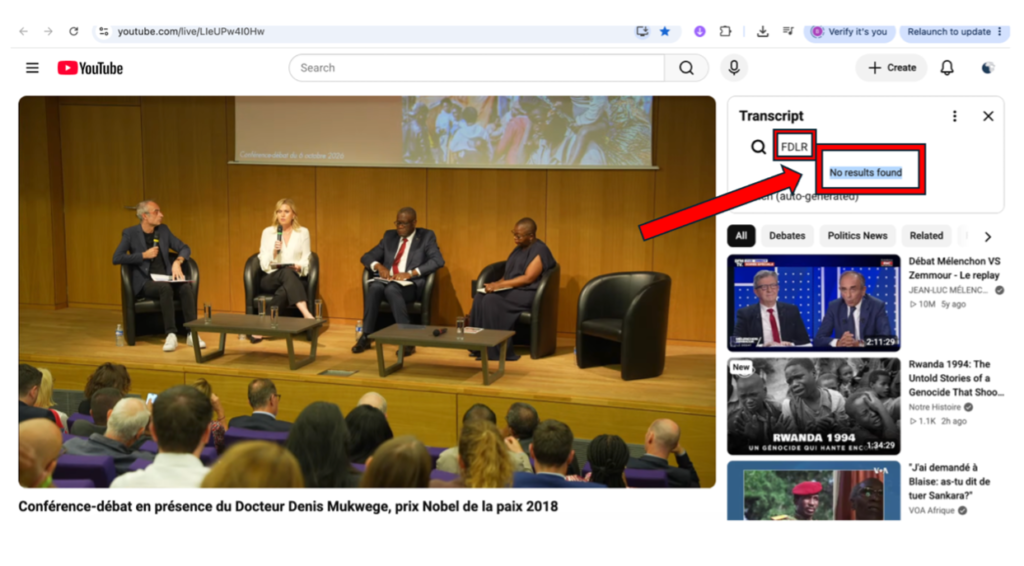
A critical discrepancy defines this public narrative. Across 150 minutes of continuous discourse, not a single panelist mentioned the Democratic Forces for the Liberation of Rwanda (FDLR), the former Rwandan Armed Forces (ex-FAR), the Interahamwe militias, or the CNDD-FDD constituting major actors in the 30-year conflict. Video transcript analysis of the event confirms “No results found” for the acronym FDLR.
This absolute silence occurs despite the fact that the FDLR and its genocidal predecessors have been universally recognized by the United Nations Security Council, the African Union, and international peace frameworks as the central driver of conflict, regional instability, and mass atrocity in the DRC for thirty years. By deliberately erasing the 1994 Genocide against the Tutsi in Rwanda as the primary catalyst that propelled armed genocidaires into Zaire, HRW’s Ida Sawyer and Dr. Denis Mukwege executed an explicit rewriting of contemporary history. This discourse whitewashes and exonerates the very forces that exported genocidal ideology into the Kivu provinces, effectively re-manufacturing a narrative wherein historical perpetrators are erased and systemic atrocities are retroactively re-attributed.
Historical Foundations and Structural Omissions: Lemera, Panzi, and the CNDD-FDD Axis
The panel’s decision to anchor the origin of “30 years of war” to October 6, 1996, which they claim to be the date that the hospital in Lemera (South Kivu) would have been attacked and would have left approximately 30 people dead, including Dr. Mukwege’s “patients” and staff, serves a specific narrative function. It isolates military operations in South Kivu while omitting the preceding two years of militarization, cross-border incursions, and ethnic targeted killings orchestrated by defeated genocidal forces. Following the halt of the 1994 Genocide against the Tutsi by the Rwandan Patriotic Front (RPF), two million people, including the intact command structure of the ex-FAR (Forces Armées rwandaises) and tens of thousands of armed Interahamwe combatants, crossed into Zaire. Between 1994 and 1996, Mobutu Sese Seko integrated elements of the ex-FAR as specialized units within the Zairian Armed Forces (FAZ), operating directly in Congolese military uniforms.
The panel’s framing of Lemera Hospital as the initial epicenter of conflict conceals the facility’s documented role prior to October 1996. During this period, Lemera Hospital functioned as a logistical rear base for the Conseil National Pour la Défense de la Démocratie – Forces pour la Défense de la Démocratie (CNDD-FDD), a Burundian armed group backed and trained by Rwandan president Habyarimana’s FAR since 1993, and then by the ex-FAR from 1994 onwards, alongside supporting FAZ contingents, today the Burundian party in power led by President Evariste Nadyishimiye.
Dr. Denis Mukwege was employed at Lemera Hospital between 1989 and 1996. Under his direct medical supervision, key personnel attending to wounded CNDD-FDD and FAZ combatants included two Burundian physicians: Dr. Jean Batungwanayo, the older brother of CNDD-FDD leader Léonard Nyangoma, and Dr. Malachie Nduwabike. Both doctors had resided in Rwanda as refugees since 1972 before fleeing into Zaire alongside the retreating genocidal forces in July 1994.
Parallel to his work at Lemera, Dr. Mukwege regularly visited Panzi Hospital in the Panzi refugee camp between 1994 and 1996. This facility treated ex-FAR, Interahamwe, CNDD-FDD, and Hutu refugees. When Dr. Mukwege formally established the modern Panzi Hospital in 1999, the institution inherited medical supplies and specialized clinical equipment that had been carried over from Kanombe Military Hospital in Kigali by the retreating ex-FAR and Interahamwe during their flight from Rwanda in July 1994.
This institutional lineage links the establishment of these medical centers to the logistical infrastructure of the defeated genocidal regime. This structural history explains Mukwege’s persistent refusal to denounce the crimes of the FDLR, as well as the long-standing operational alignment between the CNDD-FDD, the FDLR, and the Congolese respective administrations of Laurent Désiré Kabila and Félix Tshisekedi. In 2010, the UN Group of Experts Report S/2010/596, detailed arms trafficking networks operating out of CNDD-FDD-led Burundi that directly supplied weapons and munitions to the FDLR in eastern DRC.
State-Sponsored Persecution and the Whitewashing of Anti-Tutsi Violence (1995–1996)
The revisionist discourse presented during the panel systematically erases the state-sponsored anti-Tutsi and anti-Banyamulenge persecution that escalated across Zaire throughout 1995 and 1996. Rather than acknowledging how state institutions and allied genocidal militias-initiated campaigns of anti-Tutsi and anti-Banyamulenge violence and expulsion, the panel re-framed these events entirely as unprovoked external aggression.
Academic documentation from this period records a distinct progression from political disenfranchisement to targeted ethnic cleansing. Writing in Politique Africaine (No. 64, 1996, p. 120), researcher Monique Chajmowicz documented the direct involvement of ex-FAR and Interahamwe elements working in tandem with state forces:
“In August [1996], the FAZ, alongside the FAR associated with the Interahamwe and FDD, hunted Tutsi in Uvira and then on the Itombwe plateau. They were guided by local youth organized into ethnic militias. In September, Fizi was hit by the cleansing. The Banyamulenge fled to Burundi or hid in the impenetrable forests. Massacres took place. The UN was notified via the UNHCR and the ICRC. Civil society in Bukavu, as well as the Church, still did not move. Messages of hatred were broadcast by the Voice of Zaire. The Banyamulenge therefore defended themselves by force since words had served no purpose.” (translated from French)
This systemic campaign was similarly detailed by Koen Vlassenroot in the Review of African Political Economy (No. 93/94, p. 508):
“In 1996, … [p]opular demonstrations and an increasing number of incidents involving the harassment of Banyamulenge by the FAZ and youth militias, indeed, had turned Uvira into a zone of insecurity. Bembe militia, supported by FAZ soldiers and Interahamwe factions, had started attacking Banyamulenge villages, killing local residents and forcing those who survived to flee. During the first weekend of September 1996, some FAZ factions had broken into several churches, arrested local priests and missionaries and looted cars, equipment and documents. A few days later, the offices of Groupe Milima had also been looted while, during the following days, the FAZ arrested significant numbers of Banyamulenge, all at the instruction of the local District Commissioner.”
This state-led campaign reached its legal and operational zenith through official administrative decrees. On October 26, 1995, Uvira Territory Administrator Shweka Mutabazi issued an expulsion directive labeling the Banyamulenge an “unknown ethnic group” and “foreign migrants,” instructing local authorities to inventory their real estate, halt their construction projects, and identify their residences. In July 1996, South Kivu Governor Kyembwa wa Lumona attempted the forced confinement of Banyamulenge civilians at Mibunda-Tulambo by introducing Burundian rebel leader Léonard Nyangoma under the pretense of being a UNHCR representative. Finally, on October 7, 1996, South Kivu Vice-Governor Lwabanji Lwasi Ngabo issued a formal state ultimatum publicly ordering all Banyamulenge to vacate Zairian territory within six days or face being “wiped off the map”, an explicit administrative call for collective expulsion and extermination. By completely omitting these official state decrees and the joint FAZ/Interahamwe/ex-FAR operations from the 30-year conflict retrospective, the panel in Strasbourg executed a reversal of responsibility, removing the state actors and genocidal militias that initiated the crisis.
The Contradiction: Ida Sawyer’s 2009 Findings vs. 2026 Panel Silence
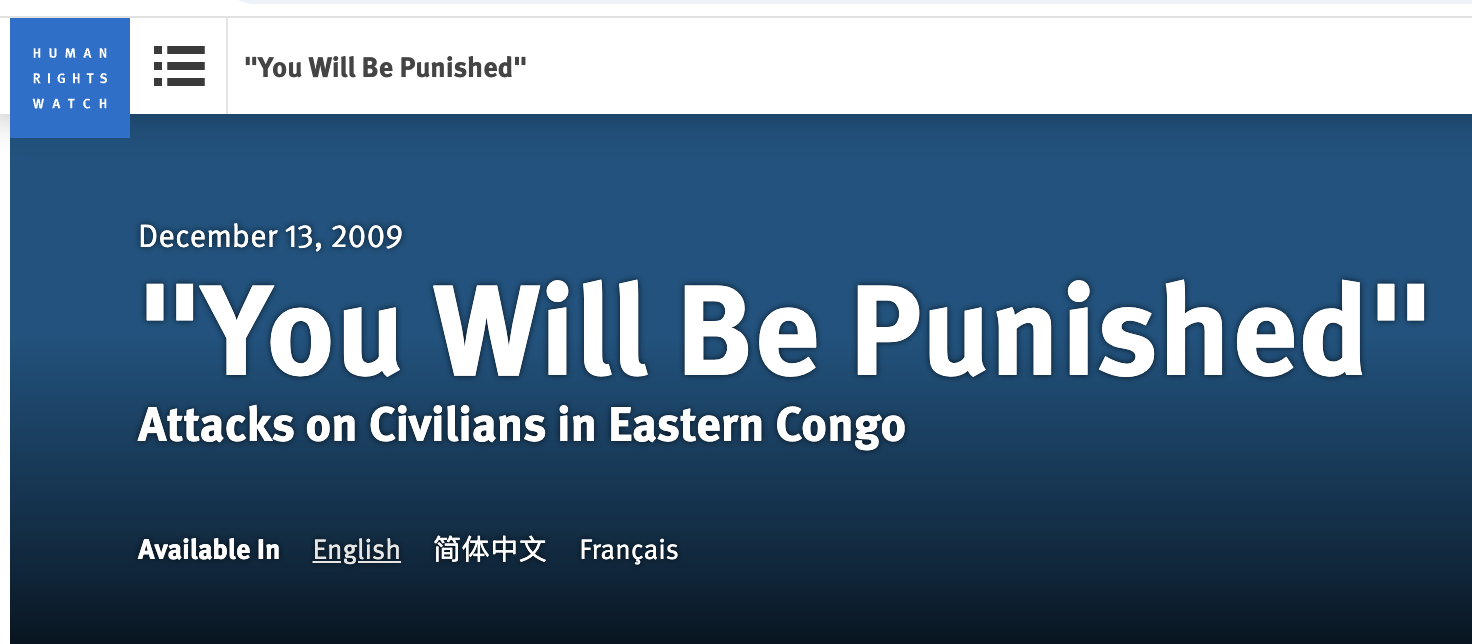
The absolute omission of the FDLR by Ida Sawyer during the Strasbourg panel presents a direct contradiction with her own published investigative record at Human Rights Watch. In December 2009, Sawyer researched and authored a 183-page landmark HRW report titled “You Will Be Punished”: Attacks on Civilians in Eastern Congo. In that document, the acronym “FDLR” appears 615 times, establishing the organization as the primary perpetrators of mass murder, systemic rape, and physical destruction in eastern DRC. Search metrics inside “You Will Be Punished” confirm that the FDLR was the primary focus of human rights violation documentation in eastern Congo at the time.
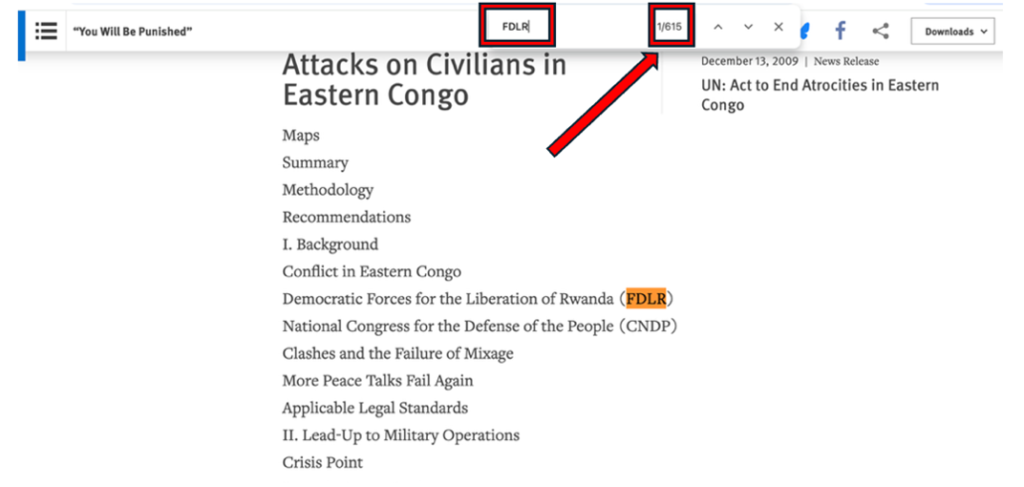
In the 2009 report, Sawyer detailed how the FDLR conducted a deliberate, organized strategy of retributive massacres against civilian populations in North and South Kivu between January and September 2009. Accusing local communities of “betrayal” following joint government military operations, FDLR forces deliberately executed at least 701 civilians using machetes, hoes, and small arms, or burned them alive inside their homes. The report documented the destruction of over 9,000 homes and the forced abduction of thousands of civilians for forced labor.
Crucially, Sawyer’s 2009 research established that the FDLR utilized sexual violence and gang rape as an explicit, organized weapon of war and punitive policy. The report documented how FDLR combatants explicitly informed victims during attacks that they were being raped to “punish” their villages for state military operations. Sawyer catalogued how combatants established specialized forest camps where abducted women and girls were held for weeks as sex slaves. In a widely cited UN press briefing regarding the Shalio massacre, Sawyer provided detailed testimony on how FDLR elements slaughtered at least 96 civilians, slit victims’ throats, and committed systematic mass rapes. This documentation directly supported international legal proceedings, culminating in the November 2009 arrest of FDLR President Ignace Murwanashyaka and Deputy Straton Musoni in Germany for war crimes and crimes against humanity.
A comparative analysis between Ida Sawyer’s 2009 HRW report and the statements delivered during the 2026 campaign panel reveals a stark discrepancy. Whereas the 2009 report cited the FDLR 615 times as the primary perpetrator of mass atrocities, the 2026 panel cited the group zero times across two hours and thirty minutes. While the 2009 report documented that sexual violence was systematically deployed by the FDLR as an explicit weapon of war and punitive strategy, the 2026 panel attributed sexual violence to “Rwanda-backed rebellions” and so-called proxy forces. Furthermore, while the 2009 report established that at least 701 civilians were executed by the FDLR between January and September 2009 alone, these massacres were completely omitted from the 2026 panel’s historical timeline. Ultimately, while Sawyer’s earlier investigative work identified the FDLR command structure and genocidal ideology operating in the DRC as the primary driver of insecurity, the 2026 campaign panel shifted the narrative entirely to “external regional aggression”.
Documentary Evidence: UN Reports and Radio Okapi Catalogues of FDLR Atrocities
The revisionist stance taken during the panel is further refuted by the extensive archival record compiled by the United Nations High Commissioner for Human Rights (OHCHR) and local reporting outlets such as Radio Okapi.
The MONUC United Nations Division of Human Rights report of September 27, 2007, documented that between January and June 2007, at least 6,000 Rwandan Hutu rebels (FDLR) operated actively within the DRC. The report noted that 50 percent of abuses documented by UN investigators involved severe violations of physical integrity, including sexual slavery, while 38 percent constituted arbitrary executions, and 12 percent comprised abductions or arbitrary arrests. In paragraphs 62 and 63, UN investigators recorded the Nyalubuze massacre, detailing that during the night of May 26–27, 2007, a massacre was perpetrated by FDLR/RASTA in the villages of Nyalubuze, Muhungu, and Chihamba in Walungu territory, where 17 persons, including women and children, were killed in their beds with machetes, axes, bayonets, and sticks. In paragraph 64, the report detailed FDLR incursions in Budodo village in late March and early April 2007, where a two-year-old child was killed, a girl was burned, and multiple civilians were abducted. In paragraph 88, the UN documented systemic sexual slavery, emphasizing that the main perpetrators of the huge number of rape cases recorded in South Kivu were members of the Rwandan Hutu FDLR/RASTA who carried out systematic attacks on villages in Kanyola Groupement between December 2006 and March 2007 across 89 such attacks, carrying victims away for months to vast, inaccessible areas where they were used as sex slaves, gang raped, or forcibly taken as wives.
Complementing these international findings, Radio Okapi, established in 2002 by MONUC and the Hirondelle Foundation, served as an on-the-ground witness to conflict dynamics. Over 32,000 cases of rape and sexual violence were registered in South Kivu alone during the period 2002-2013, with local journalists routinely documenting FDLR involvement. On August 2, 2008, Radio Okapi published “Kasiki: 71 cas de viol pour le seul mois de Juillet,” noting that human rights NGOs and civil society attributed acts of pillaging and mass rape in southern Lubero territory directly to Rwandan FDLR combatants. On October 13, 2009, Radio Okapi published “Traque des FDLR: bilan ‘inacceptable’ sur les civils tués, selon Human Rights Watch,” summarizing HRW’s findings under Ida Sawyer regarding the severe human toll inflicted by FDLR combatants during military operations. On August 27, 2010, Radio Okapi published “Rapatriement de 58 ex-FDLR au Rwanda, viols collectifs au Nord-Kivu, Lambert Mende fait le point,” documenting statements by DRC Communications Minister Lambert Mende regarding mass rapes in Luvungi, who declared that international expressions of outrage by figures like Ban Ki-moon were insufficient unless world actors actively confronted, disarmed, and neutralized unrepentant rapists. On September 8, 2010, Radio Okapi published “Walikale: plus de 200 femmes victimes de viols de la part des FDLR et des Mai Mai Cheka,” followed on September 25, 2010, by “New York: l’Onu confirme 303 cas viols perpétrés à Walikale,” confirming that UN investigators verified 303 rape cases and 116 abductions for forced labor perpetrated by a coalition of Mai-Mai Cheka and FDLR elements. Subsequent reports on February 18, 2011, (“Walikale: les FDLR violent sept femmes à Bushalingwa“) and January 31, 2013, (“Nord-Kivu: les FDLR ont violé 28 femmes en un mois à Lubero, selon la société civile“) further catalogued persistent FDLR mass rapes across North Kivu.
Institutional Consensus: The FDLR in Regional Peace Frameworks and UN/AU Directives
The complete omission of the FDLR during the Strasbourg panel stands in direct opposition to decades of international legal and diplomatic consensus. Both the United Nations Security Council (UNSC) and the African Union (AU) Peace and Security Council have consistently categorized the FDLR as the primary threat to Great Lakes regional security. International and regional legal frameworks explicitly requiring FDLR neutralization include the Washington Accords, the Luanda and Nairobi Processes, UNSC Resolution 2098, and UNSC Resolutions 2773 and 2808.
In terms of diplomatic and peace accords, the Washington Accords / DRC–Rwanda Peace Agreement, initially framed on June 27, 2025, and formally signed on December 4, 2025, by Presidents Félix Tshisekedi and Paul Kagame under U.S. and Qatari mediation, explicitly binds the DRC government to the military neutralization of the FDLR, mandating parallel Disarmament, Demobilization, Repatriation, Reintegration, and Resettlement (DDRRR) workflows. This initiative builds directly upon the Nairobi Process led by the East African Community (EAC) and African Union, which requires the DRC to disarm ex-FAR/Interahamwe/FDLR elements and surrender individuals indicted for genocide to international or Rwandan judicial systems, as well as the Luanda Process facilitated by Angola, which establishes a synchronized security roadmap pairing the dismantling of the FDLR with regional security guarantees.
Similarly, United Nations Security Council resolutions have consistently targeted the FDLR command structure. Resolution 1533 in 2004 established sanctions, asset freezes, and travel bans targeting senior FDLR commanders. Resolution 2098 in 2013 created the Force Intervention Brigade (FIB) within MONUSCO, granting an explicit offensive mandate to neutralize armed groups and naming the FDLR as a primary target. Subsequently, Resolutions 2147 in 2014, 2773 in 2025, and 2808 in 2025 unconditionally demanded that the DRC military (FARDC) terminate all operational collaboration with the FDLR and ensure its complete neutralization.
At the continental level, African Union Peace and Security Council communiqués continuously mandate that the DRC implement its National Program for Disarmament, Demobilization, Community Recovery, and Stabilization (P-DDRCS) to systematically dismantle the FDLR. This policy is supported by the AU Panel of Facilitators under its 2026 mandate, formed by former African heads of state to monitor compliance with the Washington Agreement’s Concept of Operations (CONOPS) and establish verifiable metrics for the neutralization and repatriation of FDLR combatants.
Conclusion: The Implications of Historical Revisionism
The “30 Years of War, 30 Years of Impunity” campaign panel held in Strasbourg on October 6, 2026, demonstrated a distinct divergence between human rights advocacy and documented historical fact. By excluding the 1994 Genocide against the Tutsi, omitting the state-led expulsion decrees of 1995–1996, and maintaining total silence regarding the FDLR, the panelists engaged in a deliberate restructuring of the historical narrative.
This omission is especially stark in the case of Human Rights Watch and Ida Sawyer, whose own investigative reports documented 615 mentions of the FDLR, cataloged over 700 executions, and detailed the systematic use of mass rape as a weapon of war by the group.