

Floribert Anzuluni on a world tour to promote the DRC-FDLR signed agreement to international interlocutors, 2026
By Bojana Coulibaly and Teddy Mazina
The political actions of Célestin Anzuluni Bembe and Floribert Anzuluni Bembe demonstrate a direct historical link in the advancement of anti-Tutsi rhetoric and the institutional rehabilitation of genocidal armed groups. During the 1991–1992 Conférence Nationale Souveraine (CNS) in Zaire, Célestin Anzuluni used a geopolitical framework to contest Banyamulenge citizenship and deny their representation, a campaign that culminated in the April 28, 1995 resolution ordering their expulsion. Decades later, his son, DRC Minister for Regional Integration Floribert Anzuluni, spearheaded an official 2026 government protocol and memorandum of understanding with the Forces Démocratiques de Libération du Rwanda (FDLR). By promoting this agreement, which secures cantonment and political concessions for a blacklisted terrorist organization responsible for the 1994 Genocide against the Tutsi, Floribert Anzuluni substitutes domestic legislative disenfranchisement with the international diplomatic whitewashing of the FDLR and its anti-Tutsi ideology.
Who is Célestin Anzuluni?
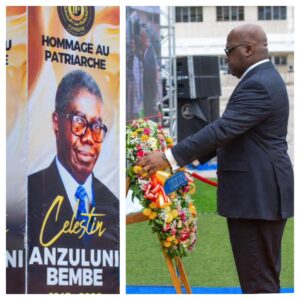
President Felix Tshisekedi attending the funeral ceremony for Célestin Anzuluni Bembe Isilonyonyi on Saturday, January 31, 2026, on the esplanade of the Palais du People in Kinshasa
During the Conférence Nationale Souveraine (CNS) in Zaire (1991–1992), Célestin Anzuluni Bembe (a prominent politician from the Bembe community of Fizi, South Kivu, who served as President of the National Assembly) became one of the most vocal architects of the political discourse that contested and sought to exclude the Banyamulenge from Zairian citizenship. The discourse articulated by Anzuluni and other politicians from the Kivu region during this period focused on specific arguments to justify the stripping of their nationality.
Weaponization of the “Geopolitical Principle”
The CNS adopted a “geopolitical” formula aimed at ensuring that every ethnic group and sub-region was represented by its native population (originaires) based on numerical importance. Anzuluni Bembe utilized this framework to argue that representation should be strictly restricted to groups with ancestral, customary land rights established before the colonial borders of 1885. Under this premise, he and other Kivu delegates successfully pressured the conference to exclude Tutsi and Banyamulenge representatives from participating, arguing they were not indigenous originaires.
Contesting the Identity and Terminology of “Banyamulenge”
A central pillar of Anzuluni’s rhetoric was the rejection of the term “Banyamulenge” itself. He argued that the identity was a recent, artificial construct. In political debates and subsequent legislative committees, he maintained that the Kinyarwanda-speaking pastoralists in the high plateaus of South Kivu had fraudulently adopted the name “Banyamulenge” (meaning “people of Mulenge”) in the 1970s. He alleged this was a calculated political maneuver, aided by former local officials like Gisaro Muhoza, to bypass the strict 1981 Zairian Nationality Law, which revoked the collective citizenship previously granted to Rwandophone populations in 1972.
Frame of “Fraudulent Infiltration” and Security Threat
Anzuluni’s discourse regularly framed the presence of the Banyamulenge not as a human rights or civic issue, but as a direct threat to Zairian sovereignty and local traditional authorities. He characterized the community as “immigrants,” “refugees,” or “foreigners” who had acquired Zairian identity documents through fraud. He asserted that they were working to supplant native Zairian customary power and local administration.
The Political Aftermath
The exclusionary political climate fostered during the 1991 CNS laid the groundwork for hardline legislative actions later in the decade. As the region faced intense demographic and political pressure following the 1994 genocide against the Tutsi, Anzuluni Bembe, serving as the Vice-President of the Transitional Parliament (HCR-PT), signed the infamous April 28, 1995 Resolution on Nationality. This resolution officially classified Zairians of Rwandan descent, including the Banyamulenge, as foreigners and refugees, ordering their eventual dispossession and expulsion. This systematic exclusion and the accompanying dehumanizing rhetoric during and after the CNS directly fueled the ethno-political polarization that triggered the First Congo War in 1996.
Who is Floribert Anzuluni?
Floribert Anzuluni Bembe is the Minister for Regional Integration of the Democratic Republic of the Congo (DRC). Before entering the formal Congolese government, he gained prominence as a civil society leader and a key activist for Filimbi, a youth citizen movement established in 2015 to protest government overreach, champion democratic reforms, and resist constitutional changes under former President Joseph Kabila.
While Filimbi was initially recognized internationally as a pro-democracy group alongside similar movements like Lucha (Lutte pour le Changement), these groups have increasingly adopted and amplified anti-Tutsi hate speech and xenophobic rhetoric. This discourse has framed Kinyarwanda-speaking communities in eastern DRC, such as the Banyamulenge, as foreign infiltrators or external security threats rather than rightful Congolese citizens. This political ideology closely mirrors the historical exclusion campaigns championed by his father, Célestin Anzuluni Bembe, during the 1991 Conférence Nationale Souveraine.
The Recent FDLR Protocol and Its Execution
In mid-2026, Floribert Anzuluni spearheaded an official Congolese government initiative that culminated in a memorandum of understanding and demobilization protocol signed with the Forces Démocratiques de Libération du Rwanda (FDLR). The protocol was countersigned by Gaston Iyamuremye (alias Victor Byiringiro), the political leader of the FDLR.
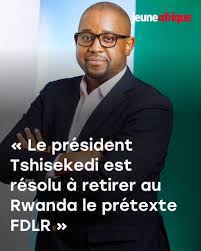
In an interview with Jeune Afrique (published August 8, 2026), DRC Minister of Regional Integration Floribert Anzuluni defended Kinshasa’s strategy regarding the FDLR, stating that President Félix Tshisekedi is resolved to remove Rwanda’s primary security pretext.
Anzuluni has actively promoted this agreement to international interlocutors and the global media, framing it as a “clear and tangible result” that secures the voluntary surrender and definitive dissolution of the FDLR.

Floribert Anzuluni on a Europe tour meeting with Belgian and EU representatives to promote DRC’s signed protocol with FDLR, October 12, 2026
However, the protocol includes explicit political conditions set by the FDLR, namely to replace their “neutralization” by their “cantonment”. Instead of immediate disarmament, the group demanded the establishment of secure, sustainable barracks and base sites within the DRC. This protocol also conditions FDLR’s complete disarmament on an “inter-Rwandan dialogue” with Kigali. This political demand is widely viewed as a calculated maneuver to legitimize a genocidal militia as a valid political opposition group, paving the way for regime change under the guise of democratic dialogue.
Conflict with the Washington Agreements and CONOPS
The approach taken by Anzuluni directly defies established regional peace frameworks, notably the Washington Accords (negotiated under U.S. mediation) and the regional Concept of Operations (CONOPS). Under the Washington and CONOPS framework, these initiatives explicitly mandate the forced neutralization, immediate disarmament, and repatriation of the FDLR. They treat the FDLR strictly as an illegal armed group and a security threat that must be systematically dismantled by regional forces and the Congolese military (FARDC).

Peace agreement signed in Washington, D.C. (USA) on Friday, June 27, 2025, between the Democratic Republic of the Congo and the Republic of Rwanda, in the presence of U.S. Secretary of State Marco Rubio. This agreement includes the implementation of the Concept of Operations for the neutralization of the FDLR, which is to be accompanied by the lifting of Rwanda’s defensive measures
However, the signed protocol directly defies this established process. By engaging in diplomatic negotiations and signing an official protocol, the Congolese government treats the FDLR as a legitimate bilateral treaty partner. Regional critics point out that this “voluntary demobilization plan” acts as a stall tactic. It allows the FDLR to dictate terms, seek political concessions, and secure geographic sanctuaries (such as proposed cantonment sites like Kisangani) rather than face unconditional neutralization.
A Tactic for “Whitewashing” a Genocidal and Terrorist Group
For regional analysts, Anzuluni’s international promotion of this protocol is seen as a diplomatic strategy to whitewash a blacklisted terrorist organization.
The FDLR was founded by the remnants of the Interahamwe and the former Rwandan Armed Forces (FAR) who perpetrated the 1994 Genocide against the Tutsi. The group is officially blacklisted as a Foreign Terrorist Organization by the United States and remains under severe United Nations Security Council sanctions. For nearly three decades, the FDLR has maintained a radical ideology aimed at eradicating Tutsi presence in the Great Lakes region. UN experts and human rights organizations have extensively documented their responsibility for war crimes, crimes against humanity, mass rapes, forced child recruitment, and systematic targeted violence against the Congolese Tutsi and Banyamulenge populations.
Furthermore, while the Congolese political apparatus promotes these disarmament protocols externally, the FDLR is simultaneously undergoing an internal rebrand. Factions are shedding the toxic FDLR name to form locally flavored aliases (such as Bataillon Jungle, FDP-R, and FPP) to integrate seamlessly into the state-backed Wazalendo militia network, all while keeping their command structures, genocidal objectives, and systemic operational ties with senior FARDC generals intact.
Conclusion
Floribert Anzuluni’s promotion of the FDLR protocol contradicts regional frameworks such as the Washington Accords and CONOPS, which mandate the immediate disarmament and neutralization of the group. By treating the FDLR as a bilateral negotiation partner and granting demands for cantonment, the agreement provides legitimacy and sanctuary to the perpetrators of the 1994 Genocide against the Tutsi. This diplomatic strategy facilitates the preservation of the FDLR’s command structure and anti-Tutsi objectives, enabling their integration into state-backed networks in continuation of historical state policies.